Optical circuit switching (OCS) is moving from Google’s in-house tool to the wider AI data center. It steers light with tiny mirrors instead of processing packets with silicon. In AI networks it can replace the spine layer, rewire GPU and TPU pods in minutes, and stay in place across several generations of optics.
Google reported 40% less power and 30% less cost in its Jupiter data center network after adding OCS (Google Cloud). Analyst firm Cignal AI now expects the OCS market to pass $8 billion by 2030 (Cignal AI, 2Q26).
This article explains what OCS is, how it works, where it fits in an AI fabric, what it is worth, and when it is the right choice for your network.
What is optical circuit switching?
An optical circuit switch connects an input fiber to an output fiber by steering the light itself. It never reads a packet. Once a path is set, it stays put until software changes it, like an automated patch panel at data center scale.
An electrical packet switch (EPS) works differently. Every packet is converted from light to electricity, its header is parsed, it is queued and forwarded, then converted back to light. That optical-electrical-optical (OEO) round trip costs power, adds latency, and ties the switch to one line rate.
| Electrical packet switch (EPS) | Optical circuit switch (OCS) | |
|---|---|---|
| What it switches | Individual packets | Whole light paths (circuits) |
| Signal path | Optical → electrical → optical | Stays optical end to end |
| Line rate | Fixed by the ASIC and optics (e.g. 400G, 800G) | Rate- and protocol-agnostic |
| Reconfiguration | Per packet, nanoseconds | Per circuit, typically milliseconds |
| Features | ACLs, QoS, telemetry, load balancing | None at the packet level |
| Power | Continuous, scales with bandwidth | Mainly when mirrors move |
Four terms come up often:
- Radix is the port count, written as inputs × outputs, such as 136×136 or 300×300.
- Reconfiguration time is how long the switch takes to set up a new circuit.
- Insertion loss is the optical power lost through the switch, in dB. It eats into the transceiver’s link budget.
- Topology engineering means changing which blocks are connected to which, in software, to match traffic.
How the technology works
Most production OCS today use 3D MEMS mirrors. Light from an input fiber hits a tiny mirror that tilts on two axes. It bounces to a second mirror array that aims it into the chosen output fiber. Software computes the tilt angles. After that the path is passive, so the switch draws little power until the next change (Lumentum).
Google’s in-house Palomar switch is a 136×136 3D-MEMS design with millisecond switching and about 2 dB worst-case insertion loss. It is the basis of Google’s Apollo optical layer (Inside Deep Tech). Lumentum’s commercial R300 offers 300×300 ports with typical insertion loss of 1.5 dB or less.
MEMS is not the only approach. An April 2026 Open Compute Project survey compares six technologies:
| Technology | Radix | Loss | Switching time | Where it fits |
|---|---|---|---|---|
| 3D MEMS beam steering | Large | Low–medium | Milliseconds | Production hyperscale workhorse |
| Liquid crystal (LCoS) | Medium | Medium | Milliseconds | Needs polarization handling |
| Piezoelectric | Medium | Medium | Milliseconds | More mechanical complexity |
| Robotic fiber | Large | Low | Seconds to minutes | Latching patch automation |
| Silicon photonics | Low–medium | Higher at scale | Nanoseconds to microseconds | Often needs amplifiers (SOAs) |
| Metasurface | Large | Medium | Microseconds | Emerging |
Source: OCP 2026 survey as summarized by Inside Deep Tech.
Two optics tricks matter in practice:
- Circulators let one fiber carry traffic in both directions. That effectively doubles the usable ports on each switch.
- WDM transceivers put several wavelengths on one fiber. Because the switch is wavelength-agnostic, it carries all of them through one port. This is why OCS deployments favour single-fiber optics (FR-type) over multi-fiber parallel optics (DR-type) (Cignal AI).
Design: where OCS fits in an AI fabric
OCS does not replace every switch. It takes over the layers where traffic patterns are large, predictable and long-lived. Leaf and top-of-rack switches stay electrical, because servers still need packet forwarding, load balancing and telemetry.
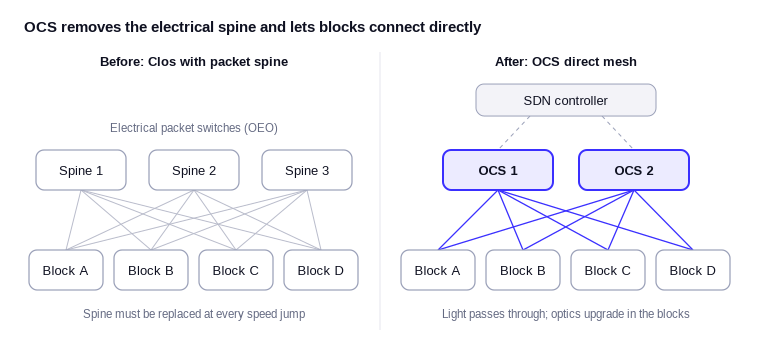
Pattern 1: Replace the spine (scale-out)
In a classic Clos fabric, every aggregation block connects to a spine layer of electrical switches. The spine must run at the fastest speed of the day and is hard to grow without rewiring the building.
Google removed that spine. Its aggregation blocks now connect through OCS in a direct mesh, and the SDN controller (Orion) chooses which blocks talk to which. Reconfiguring that logical topology is “standard operating procedure” with no application-visible impact (Google Cloud).
Pattern 2: Build reconfigurable AI pods (scale-up)
Google’s TPU v4 supercomputer links 4,096 chips. It is built from 64 “cubes” of 64 TPUs, joined by 48 OCS units (Inside Deep Tech). The OCS layer lets operators:
- carve slices of different sizes for different jobs
- pick the topology that suits a model, such as a 3D torus
- route around a failed cube, so week-long training runs keep going (Google Cloud)
Google’s later Ironwood generation scales this to a 9,216-chip superpod of 144 cubes, using spare cubes to bypass failures (Inside Deep Tech).
Pattern 3: Job-aware overlay
OCS can also sit beside an existing packet network. It gives a training job dedicated optical circuits between the GPU nodes it uses, removing electrical hops for the heaviest flows (Lumentum). Cignal AI expects GPU scale-up designs, including NVIDIA’s planned NVL576, to adopt OCS around 2028–29 (Cignal AI).
Design checklist
- Optical budget. Add the switch’s insertion loss (about 1.5–2 dB) to fiber and connector loss, and check it against the transceiver’s budget. Plan for one OCS hop, two at most, without amplification.
- Optics choice. Prefer single-fiber, WDM optics. Consider circulators to double port efficiency.
- Control plane. You need software that computes topologies, drains links before a change, and reprograms the switch. Vendors such as Lumentum expose this through SONiC and gNMI.
- Failure domains. Spread each block’s uplinks across several OCS units, so losing one switch removes only a slice of capacity.
- Fiber plant. OCS becomes long-lived building infrastructure. Design structured cabling for it the way you would for patch panels.
Value: what OCS delivers
The strongest public evidence comes from Google’s production networks. These are Google’s own figures against its own baselines, so treat them as an upper reference point rather than a guarantee.
| Result | Reported figure | Where |
|---|---|---|
| Network power | 40% less (41% in the SIGCOMM paper) | Jupiter data center network |
| Network cost | 30% less | Jupiter |
| Throughput | 30% higher | Jupiter |
| Flow completion time | 10% lower | Jupiter |
| Downtime | 50× less than best known alternatives | Jupiter |
| OCS share of system cost and power | Under 5% each | TPU v4 supercomputer |
| Training throughput with failed servers | About 75% vs about 25% for a static fabric | TPU v4 superpod |
Sources: Google Cloud, Jupiter, Google Research, Jupiter Evolving, Google Cloud, TPU v4, Inside Deep Tech.
The value comes from five places:
- Power. No OEO conversion and no packet ASIC at the spine. A MEMS switch uses energy mainly when its mirrors move.
- Latency. Light passes straight through, with no queueing or serialization at that layer.
- Future-proofing. The switch is rate- and wavelength-agnostic. Google notes it does not need upgrading as links move from 40G to 100G to 200G and beyond, so it becomes part of the building (Google Cloud).
- Incremental growth. New, faster aggregation blocks can join beside older ones, with hitless, localized changes instead of an all-at-once spine refresh.
- Availability and utilization. Software can steer around failures and reshape the topology to fit each job, so expensive accelerators spend less time idle.
Limitations and trade-offs
OCS is a circuit switch, not a smarter packet switch. Those gains come with real constraints.
- No packet features. Each input maps to one output. There is no per-packet QoS, ACL, header inspection or switch-level telemetry at the OCS layer.
- Slow to change. MEMS switches reconfigure in milliseconds. That suits job-level and topology-level changes, not per-flow or per-packet decisions.
- Optical budget. Every OCS hop adds insertion loss, so designs are practically limited to one or two hops without amplification.
- Software is the hard part. You need an SDN control plane that engineers topologies, drains traffic safely, and integrates with routing. Google built Orion for this. Most operators will rely on vendor software or open tools such as SONiC.
- Not a drop-in. OCS changes cabling, optics choices and operations. It does not replace NVLink, InfiniBand or leaf switches, and it is not co-packaged optics.
- Young ecosystem. Until recently, almost all OCS revenue came from Google. Merchant supply, standards and operational experience outside hyperscalers are still building up (Cignal AI).
When to consider OCS
Consider OCS when most of these are true:
- Your AI cluster is large, with thousands of accelerators or more, and the spine is a major share of network power and cost.
- Traffic between blocks or pods is heavy and fairly predictable, as in large training jobs.
- You expect two or more transceiver generations (for example 800G to 1.6T) during the building’s life, and want the core to stay in place.
- You grow in phases and want to add new blocks without rewiring the whole fabric.
- Job availability matters, and routing around failed racks or pods would recover real accelerator time.
- Your team, or your vendor, can run an SDN control plane and automated topology changes.
- Your optical budget can absorb one OCS hop.
Stay with an all-electrical fabric when:
- the cluster is small, or the spine is a minor cost
- traffic is bursty and unpredictable and needs per-packet multipathing
- you need ACLs, deep inspection or per-flow telemetry at that layer
- your operations are not yet automated
A practical path for most teams is to start with a pilot. Put OCS at the spine or pod-interconnect layer of one cluster, keep leaf switches electrical, and measure power, availability and operating effort before scaling.
Practise the fundamentals first. You can build and break leaf–spine fabrics on your own workstation with VEX-NX. OCS hardware itself is not emulated.
Market and outlook (late 2026)
OCS is moving from one buyer to an industry. Google has spent well over $1 billion on OCS to date, and its TPU networks are still the only volume application. Cignal AI forecasts the market will pass $8 billion by 2030, with GPU scale-up driving most of that growth (Cignal AI, 2Q26).
| Company | Position |
|---|---|
| Pioneer; in-house Palomar 3D-MEMS switch behind its Apollo optical layer | |
| Lumentum | R300, 300×300 MEMS; OCS backlog “well beyond $400 million” (Feb 2026) |
| Coherent | 320×320 OCS platform; sees an addressable market above $4 billion |
| Others | Huber+Suhner, Telescent, iPronics, DiCon, nEye, Calient, Salience Labs and more than a dozen others (Cignal AI) |
Lumentum and Coherent details: Inside Deep Tech.
Three trends to watch:
- Open standards. An April 2026 Open Compute Project white paper on OCS was backed by Lumentum, Coherent, Ciena, Microsoft, NVIDIA and others.
- More bandwidth per port. Google is pushing “Coherent Lite” optics at 2.4T as an interim step to 3.2T, to carry more data through each scarce OCS port (Cignal AI).
- Faster switching. Vendors are targeting microsecond-class switching, which would open up optical burst switching beyond today’s millisecond circuits (Lumentum).
Key takeaways
- OCS switches light paths, not packets. It is power-efficient, rate-agnostic and reconfigurable in software.
- In AI networks it fits best at the spine and at pod interconnect, with leaf switches staying electrical.
- Google’s production numbers (40% less power, 30% less cost, 50× less downtime) show the potential at hyperscale.
- The trade-offs are millisecond switching, no packet features, a tight optical budget, and a heavy reliance on control-plane software.
- Consider it for large, predictable, long-lived AI fabrics. Start with a pilot.
FAQ
Is OCS the same as co-packaged optics (CPO)? No. CPO moves optics next to the switch chip inside a packet switch. OCS removes the packet switch from a layer altogether.
Does OCS replace InfiniBand or Ethernet? No. Endpoints and leaf switches still run InfiniBand or Ethernet. OCS changes which ports are physically connected underneath.
How fast does an OCS switch? Production MEMS switches reconfigure in milliseconds. Silicon photonics can reach nanoseconds to microseconds, but at smaller port counts and higher loss.
Why does Google use it and others are only starting? Google spent years building the switch, optics and SDN control plane together. Merchant switches and open standards only became widely available in 2025–26.
Sources
- The evolution of Google’s Jupiter data center network, Google Cloud
- Jupiter Evolving (SIGCOMM 2022), Google Research
- TPU v4 enables performance, energy and CO2e efficiency gains, Google Cloud
- Optical Circuit Switching Market – 2Q26, Cignal AI
- Optical Circuit Switching: A Full Guide to Photonic Fabrics, Inside Deep Tech (September 2026)
- Optical Circuit Switches in AI Hyperscale Data Centers – The MEMS Advantage, Lumentum
- R300 300×300 Optical Circuit Switch, Lumentum